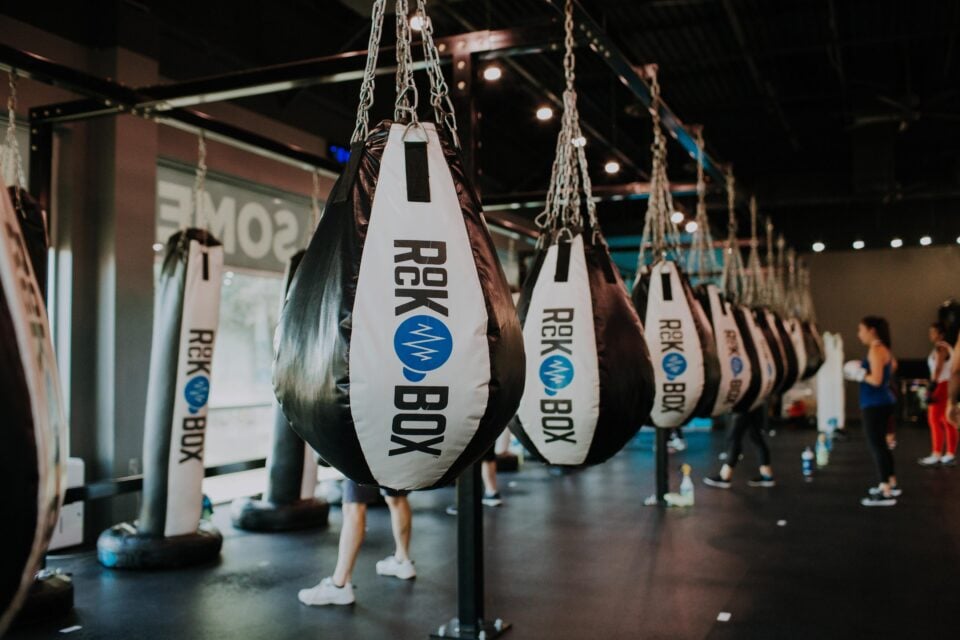
Yes. Boxing builds real muscle, particularly lean functional muscle through the shoulders, back, core, and legs. It will not add size the way heavy barbell training does, because the stimulus is different. What boxing produces is dense, athletic muscle built for power and endurance, and most boxing-based fitness classes pair the bag work with strength training that drives the gains further.
If you have only ever thought of boxing as cardio, that assumption is worth revisiting. A round on the heavy bag is resistance work. The bag pushes back, every punch travels from the floor through your hips and core, and doing that for three minutes at a time under fatigue is a genuine stimulus for muscle.
How Boxing Builds Muscle
Muscle grows in response to tension, volume, and progressive demand. Boxing delivers all three, just in a different package than a traditional lifting session.
The tension comes from impact. Striking a heavy bag is resisted movement, and your muscles have to both generate force and absorb it on the way back. The volume comes from repetition. A single round can involve well over a hundred punches, and a full class stacks round after round. That high-repetition, moderate-load pattern is the same stimulus that builds muscular endurance and lean tissue in any training context.
The demand comes from doing it under fatigue. As your conditioning improves, you punch harder for longer, which means the load keeps climbing even though you never touch a barbell. That is progressive overload, delivered through intensity rather than added weight.
There is a second mechanism that matters just as much. Boxing is a full-body chain movement. Power starts in the legs, transfers through the hips and core, and finishes at the fist. Nothing about that is isolated. Your body adapts by building coordinated strength across the whole chain, which is why boxers tend to look athletic rather than blocky.
What Muscles Does Boxing Work?
Boxing is closer to a full-body workout than most people expect. The muscles doing the most work are these.
Shoulders and arms. Deltoids carry the load on every punch thrown and every guard held. Triceps drive extension on straight punches, biceps handle hooks and the retraction, and forearms work constantly to keep the fist tight and the wrist stable.
Core and obliques. Rotation is where punching power actually comes from. Every hook and cross rotates the torso, which makes the obliques and the deep core some of the hardest-working muscles in a boxing session. This is why people notice core definition from boxing before almost anything else.
Back. Lats and rhomboids stabilize the shoulder through the punch and pull the arm back to guard. They are also doing quiet work the entire time you hold your hands up, which over a 50-minute class adds up more than it sounds.
Legs and glutes. Footwork keeps the legs under constant low-grade load, and the drive for a powerful punch starts with the back foot. Quads, hamstrings, glutes, and calves all contribute, which is why boxers rarely skip leg day by accident.
Chest. Pectorals assist on straight punches and hooks, working with the shoulders rather than as the prime mover.
The short version is that boxing trains the whole chain rather than isolating parts of it, which builds the kind of strength that transfers into everything else you do.
Is Boxing a Good Workout?
It is one of the more complete workouts available, because it trains several qualities at once rather than one at a time.
You get cardiovascular conditioning, since heart rate climbs and stays elevated through rounds. You get muscular endurance from high-repetition striking. You get power development from explosive movement. You get coordination, balance, and reaction time from learning actual technique. And you get the mental piece, which is the part people rarely expect and often stay for, because it is difficult to carry a stressful day into a round on the bag.
Compared with a treadmill or a standard weights session, boxing covers more of those qualities in a single 50-minute block. That efficiency is a large part of why boxing-based group fitness keeps growing.
The tradeoff is honest and worth stating. If your single goal is maximum size, barbell training with heavy progressive loading will get you there faster. Boxing builds lean muscle and exceptional conditioning. It is not a hypertrophy program, and any gym telling you otherwise is overselling.
Will Boxing Make You Bulky?
No, and this is one of the most common concerns from people new to the sport, particularly women.
Boxing builds lean muscle rather than mass because of how the stimulus works. High repetition with moderate resistance, combined with significant cardiovascular demand, favors muscular endurance and density over size. Adding substantial mass requires heavy progressive loading and a consistent calorie surplus, neither of which describes a boxing class.
What people typically notice instead is that they look more defined. Body fat comes down from the conditioning demand while lean tissue holds or increases, which sharpens the shoulders, arms, and midsection without changing your overall frame. That combination is why boxing appeals to people who want to look strong rather than large.
Getting the Most Muscle From Boxing Training
A few things make a real difference in how much muscle you build.
Pair bag work with resistance training rather than treating them as alternatives. Boxing classes that build in bodyweight strength, weights, or explosive work will always produce more muscle than striking alone. This is exactly why coached class formats tend to outperform hitting a bag on your own.
Eat enough protein. Muscle is built from what you eat as much as what you train, and boxing burns through a lot of energy. If you train hard and eat too little, you get leaner without getting stronger.
Recover deliberately. Shoulders in particular take a beating in boxing, and they are easy to overtrain because they work on every punch. Give them real rest days rather than stacking sessions.
And prioritize technique over intensity early on. Good form transfers force efficiently through the chain, which means better muscle recruitment and a lower injury risk. Punching harder with bad mechanics mostly produces sore joints.
What This Looks Like at RockBox
RockBox Fitness classes are built around exactly this combination. Each 50-minute class pairs boxing and kickboxing on the bags with functional strength training, rotating through 8 to 12 stations so you get the striking volume and the resistance work in the same session rather than choosing between them.
Coaches guide the technique, which matters more than most people expect for muscle building, because efficient force transfer is what makes the bag work productive rather than just tiring. Gloves and wraps are provided, classes are built for every fitness level from complete beginners to experienced athletes, and no two sessions repeat.
If you want to see what it feels like, your first class is free at any RockBox studio.
Frequently Asked Questions
Does boxing build muscle?
Yes. Boxing builds lean, functional muscle, most noticeably in the shoulders, back, core, and legs. The stimulus comes from resisted striking on the heavy bag, high repetition volume, and working under fatigue, which together drive muscular endurance and density. Boxing will not add size the way heavy barbell training does, but boxing-based classes that pair bag work with strength training produce meaningful muscle gains.
What muscles does boxing work?
Boxing is close to a full-body workout. Shoulders and arms carry every punch and guard, the core and obliques generate rotational power, the back stabilizes the shoulder and holds the guard, and the legs and glutes drive force from the floor upward. The chest assists on straight punches. Because power travels as a chain from the back foot to the fist, boxing trains these muscles together rather than in isolation.
Is boxing a good workout?
It is one of the more complete workouts available, because it trains cardiovascular conditioning, muscular endurance, power, coordination, and mental focus in a single session. A 50-minute boxing class covers more training qualities than an equivalent block of steady cardio or isolated lifting. If maximum muscle size is your only goal, heavy barbell training is more direct, but for overall fitness boxing is difficult to beat for efficiency.
Will boxing make me bulky?
No. Boxing builds lean muscle rather than mass, because high-repetition striking with moderate resistance and heavy cardiovascular demand favors endurance and density over size. Adding significant mass requires heavy progressive loading and a calorie surplus, which a boxing class does not provide. Most people find they look more defined instead, as body fat decreases while lean muscle holds or increases.
Does kickboxing build muscle too?
Yes, and it adds lower-body development that boxing alone does not. Kicks and knee strikes load the glutes, quads, hamstrings, and hip flexors far more heavily than footwork does, while the balance demand of striking on one leg recruits the core and stabilizers. Classes combining boxing and kickboxing, as RockBox does, distribute the work more evenly across the whole body.
Is boxing better than lifting weights for building muscle?
They do different jobs. Heavy lifting with progressive loading is the more direct path to muscle size. Boxing builds lean muscle alongside conditioning, coordination, and power, which weights alone do not deliver. For most people the honest answer is that combining them works best, which is why boxing classes that build in strength training produce better results than striking on its own.
How often should I box to build muscle?
Three to four sessions a week is a reasonable target for most people, leaving room for recovery. Shoulders work on every punch and are easy to overtrain, so consecutive hard days are worth avoiding. Consistency over months matters more than frequency in any single week, and pairing your boxing sessions with adequate protein and sleep will affect results more than adding a fifth class.
Can beginners build muscle from boxing?
Yes, and beginners often see the fastest changes. Early progress comes from learning to transfer force efficiently through the chain, which recruits more muscle with every punch as technique improves. Coached classes accelerate this considerably compared with hitting a bag unsupervised, because form correction is what turns effort into productive training.
The Bottom Line
Boxing builds muscle, and specifically the kind most people actually want: lean, functional, and built for power rather than size. The heavy bag provides real resistance, the volume is high, and the whole-body chain means nothing gets skipped.
To get the most from it, train with a format that pairs striking with resistance work, eat enough to support the training, and give your shoulders proper recovery. Do that consistently and the changes show up in how you look and in what your body can do.
Book your free class and train like a fighter, whatever your experience level.